
The 3-Layer Framework to Decide Your Career Direction

By Akash Dhotre
When I was working with data systems in New York, we never made critical business decisions based on “gut feeling.” We didn’t launch strategies because they “felt right.” We used models. We analyzed variables. We looked for the signal amidst the noise.
Yet, when it comes to the most expensive investment of our lives—our careers—most of us are still guessing.
Growing up in Mumbai, the career menu often felt limited to two options: Engineering, or Medicine. If you were ambitious, you picked one and ran the race. But the world has shifted. The linear path from “Good Degree” to “Safe Job” to “Retired Life” has dissolved.
Today, you don’t just find a career; you have to architect one.
If you are standing at a crossroads—whether you are a student in Ahilyanagar or a young professional in Mumbai feeling stuck—you don’t need more motivation. You need a filter.
Over the last decade, navigating from local startups to American giants like IBM, I’ve used a specific mental model to make decisions. It isn’t about passion, and it isn’t just about money. It is about alignment.
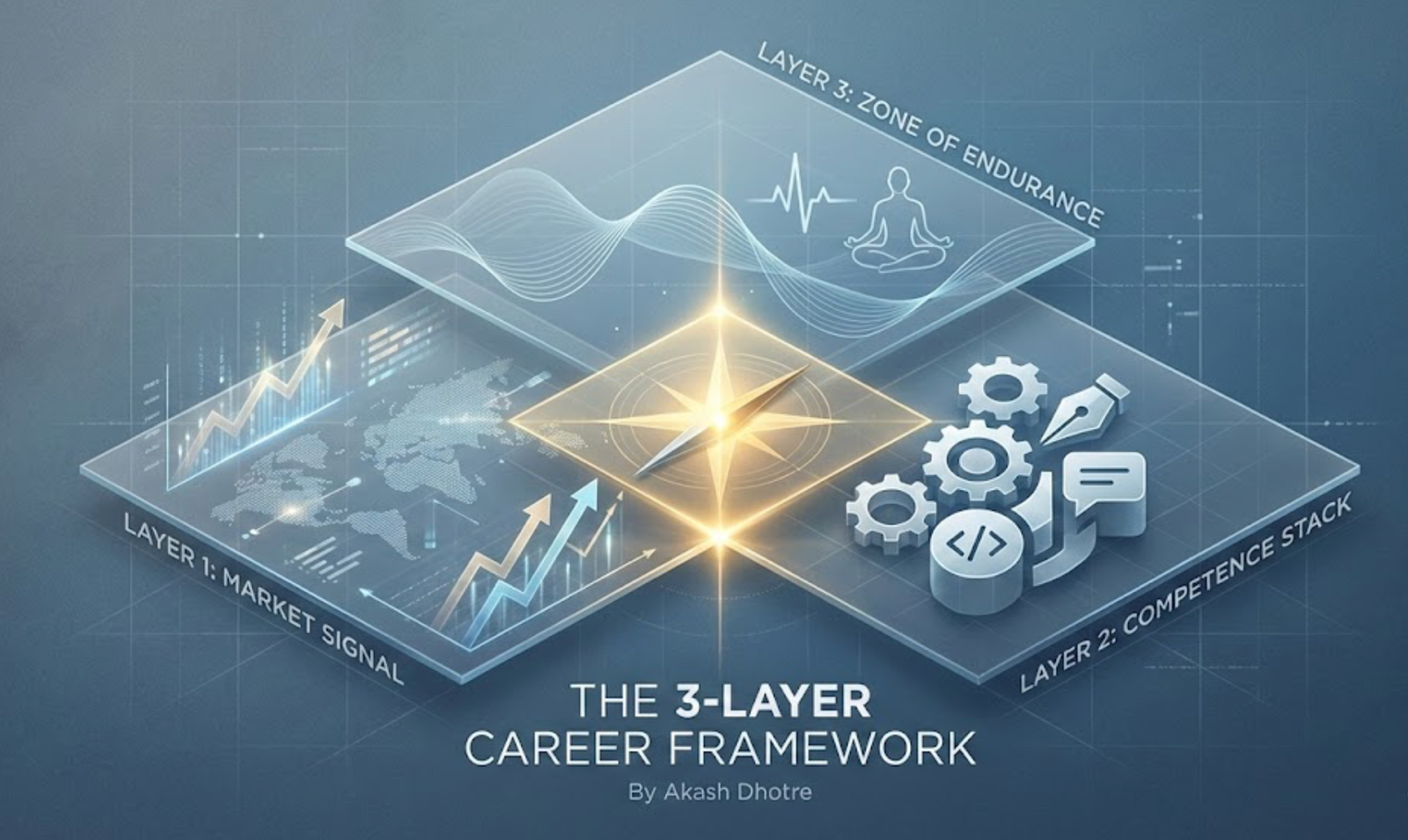
I call it the 3-Layer Career Framework.
Layer 1: The Market Signal (External Reality)
The first layer is not about you. It is about the world.
A common mistake I see in early-stage professionals is starting with “What do I love?” This is a trap. You can love something that has zero economic value. In the world of business strategy, we call this “Product-Market Fit.” You are the product; the economy is the market.
Before you choose a direction, you must audit the external reality.
- Where is the capital flowing? (e.g., currently: AI, Green Energy, Digital Health, Supply Chain Automation).
- What problems are expensive to leave unsolved?
- Is this industry growing or shrinking?
When I decided to specialize in AI at MIT, it wasn’t just because I found it interesting. It was because the market signal was deafening. I saw that every industry—from finance to farming—was about to be rewritten by algorithmic intelligence.
The Actionable Step: Stop looking at job titles. Look at problems. A job title is a label; a problem is a market. If you can solve a complex problem (like “how to automate customer service for small businesses”), you will always have a career, regardless of what the job title is called.
Layer 2: The Competence Stack (Internal Asset)
The second layer is your “Unfair Advantage.”
In a global economy, being “average” at a generic skill is risky. If you are an average coder, you are now competing with AI. If you are an average writer, you are competing with ChatGPT.
To build a robust career, you need to stack skills. This is a concept I learned watching successful leaders in New York. They were rarely the best at just one thing. They were the best at the intersection of two things.
- The Engineer who can Sell.
- The Designer who understands Data.
- The Marketer who knows No-Code Automation.
This is your Competence Stack.
For me, the stack was Data Analytics + Business Strategy + Digital Storytelling. Individually, I was competent in each. But combined? I became a “translator” between the technical teams and the business boardrooms. That is a rare and valuable position.
The Actionable Step: Don’t just ask “What am I good at?” Ask “What two skills can I combine that are rare to find together?” If you are a student in a tier-2 city, your English communication might be average, but your understanding of local tier-2 consumer behavior is elite. Combine that. That is your leverage.
Layer 3: The Zone of Endurance (Sustainability)
The third layer is the most overlooked. It is the “Swasthya” (Health/Wellbeing) of your career.
You can find a high-paying market (Layer 1) and build a rare skill stack (Layer 2), but if you hate the daily reality of the work, you will burn out before you compound your success.
In the “hustle culture” of Mumbai and New York, I saw brilliant people collapse because they were running a race they didn’t actually want to win. They were optimizing for prestige, not endurance.
Endurance is a competitive advantage.
If you can stay in a game for 10 years while others quit after two, you win by default. This requires self-awareness. Do you thrive in chaos and high pressure (Startup environment)? Or do you prefer structure and depth (Research/Institutional environment)?
The Actionable Step: Ask yourself, “What is the pain I am willing to sustain?” Every career has pain. The coder has the pain of debugging. The founder has the pain of uncertainty. Pick the pain you can handle.
The Intersection: Where the Magic Happens
Your ideal career direction lies at the center of these three circles:
- Market Signal: The world needs it.
- Competence Stack: You are uniquely good at it.
- Zone of Endurance: You can do it for a decade without losing yourself.
When I moved back to work on projects that bridge the US and India, it was because this intersection became clear. The market for cross-border digital strategy is huge. My stack of “Tech + Culture” fits perfectly. And working from anywhere—be it a cafe in Bali or my home in Ahilyanagar—fits my zone of endurance.
A Final Note to the Tier-2 Ambition
You might feel that being in a smaller town puts you at a disadvantage.
I want to reframe that.
In a digital world, your location is not your limitation; it is your context. The internet has flattened the playing field, but it hasn’t flattened the competition. To win, you don’t need to be in Silicon Valley. You need to be strategic.
Stop guessing. Stop following the herd. Start architecting.ursus turpis massa tincidunt dui ut. Volutpat odio facilisis mauris sit amet massa vitae tortor condimentum. Eget duis at tellus at.